

About the Author
Sister Jordan Thomas, O.P. SAGI Torchbearer & SAGI Senior Advisor, Inspiring Faith and Theocentric Education
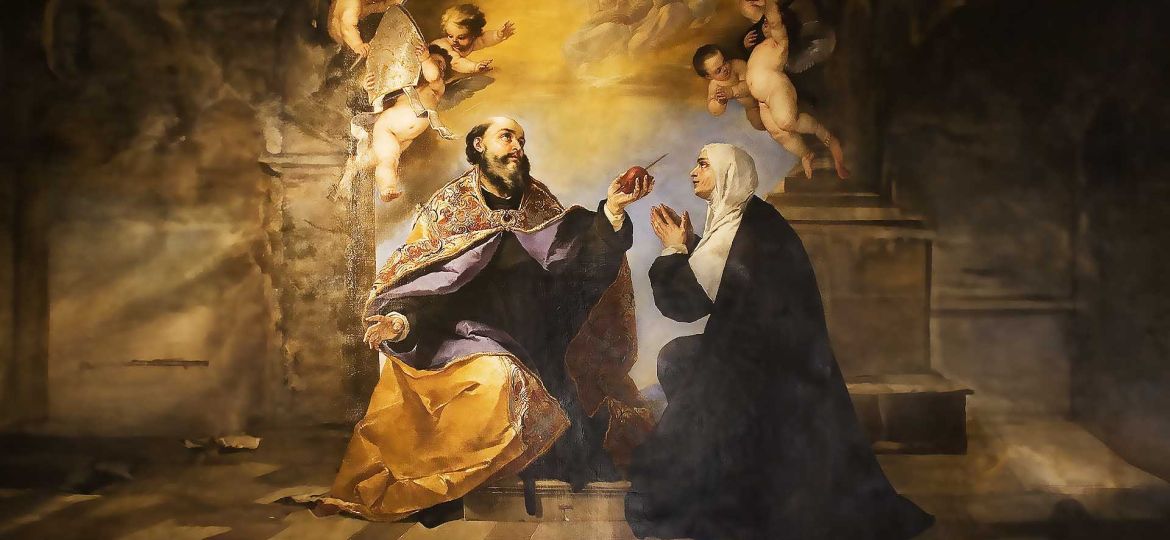
ST. MONICA: MOTHER OF ST. AUGUSTINE
Words of Wisdom: “It is impossible to set any bounds to what persevering prayer may do. It gives man a share in the Divine Omnipotence. St. Augustine’s soul lay bound in the chains of heresy and impurity..... They were broken by his mother’s prayers.” (John Gilmary Shea, Little Pictorial Lives of the Saints) (1)
St. Augustine of Hippo, one of the Church’s most illustrious bishops and theologians, is known for his ardent love of God, his prudence and justice as a prelate, and his extraordinary theological contributions as one of the Four Great Doctors of the Western Church. Augustine’s engaging autobiography, Confessions, which contains a detailed account of his life, conversion, and spirituality, remains one of the most widely read works of Christian literature. However, integral to Augustine’s life and contributions is the history of another important saint: St. Monica, who was not only Augustine’s natural mother but also his spiritual mother. By her constant prayers and sacrifices for the conversion of Augustine while he had been immersed in sin and heresy, Monica was particularly instrumental in bringing about his eventual change of heart, thus giving to the Church a great saint.
EARLY LIFE AND MARRIAGE
St. Monica was born to a Catholic family in North Africa in A.D. 333. (2) Pious and intelligent, Monica spent her childhood in the care and education of a tutor who instructed her in the truths of the Faith and who also saw carefully to her disciplined upbringing. (3)
At a young age, Monica was given in marriage to a pagan named Patricius, for whose conversion she prayed fervently and to whom she strove to be an example of a true Christian. Among Monica’s habitual practices were daily attendance at Mass, visits to the church for public prayer, and the study of the lives of the saints. Monica was also attentive to the needs of the materially unfortunate, as she frequently distributed alms to the poor. Moreover, she found great spiritual value and merit in the performance of simple, daily tasks for the love of God––a practice in which many other saints, such as St. Thérèse of Lisieux, also found a solid means of progressing quickly in sanctity. (4)
Monica faced immense trials in her marriage, as Patricius’ adultery and his choleric outbursts posed great strain on their relationship. Nevertheless, she bore these sufferings with patience, finding her strength and peace in God and continuing to pray fervently for her husband’s conversion. Monica thus became an edifying model to other wives and mothers who knew her, and they became inspired to imitate her patience and charity. Only one year before he died, Patricius received the grace of conversion: moved at last by Monica’s prayers and good works, he renounced his sinful habits and became Catholic. (5)
MOTHER OF SAINT AUGUSTINE
Monica and Patricius had two sons and one daughter, the eldest of their children being Augustine. (6) Although Monica did her utmost to instill Catholic truths and morals into her children, Augustine eventually chose to reject his mother’s instructions and, instead, to follow his ambitions, lust, and personal judgments. At the age of sixteen years, shortly before he was sent to Carthage for his studies, Augustine plunged himself into a life of sin from which he would not emerge for many years. (7)
Augustine also soon lost his faith and began to zealously follow Manichaeism (a religion that taught a form of dualism). Such was Augustine’s enthusiasm for Manichaeism that, for nine years, he was among its greatest proponents, devoting himself to its defence and drawing others into its snare. (8)
SPIRITUAL MOTHER
As Augustine recounted later in his Confessions, Monica, when she became aware of her son’s loss of faith in addition to his sinful practices, “wept... on my behalf more than mothers are wont to weep the bodily death of their children.” (9) However, she wholeheartedly entrusted Augustine’s soul to the goodness and mercy of God. Further, although her admonitions to Augustine were of little avail, she began to make constant prayer and sacrifice for him, asking God to grant him the grace of conversion. Monica continued this holy work for over fifteen years. (10) By her solicitude for Augustine’s soul, Monica, in addition to already being his natural mother, also became his spiritual mother.
As Augustine continued to show no interest in conversion, Monica one day expressed her sorrows to a learned bishop who was himself a convert from Manichaeism. He encouraged her to patience and perseverance in her prayer and good works, and he reassured her that “God’s time would come,” and that “it is impossible that a child of such tears should perish.” (11)
A GREAT CONVERSION
After moving to Milan to teach rhetoric, Augustine providentially encountered one of the most prominent Catholic scholars and bishops of the fourth century: St. Ambrose of Milan (d. 397) (12)––an indefatigable defender of orthodoxy, who was known for his charity, kindness, and wisdom. (13) As Ambrose was also renowned for his great learning, Augustine––though still not seeking to become Catholic––took interest in hearing Ambrose preach. Ambrose’s sermons became an important means by which Divine Providence helped Augustine to gradually discover the truth. (14)
When Monica relocated to Milan to live in closer proximity to Augustine, he informed her of his decision to renounce his adherence to Manichaeism. Due in great part to Ambrose’s good influence, Augustine had come to see the erroneousness of the sect to which he had so long dedicated himself. Although Augustine’s dissociation with Manichaeism did not yet involve his embracing Catholicism, nevertheless, Monica was immensely thankful to God, Who had given Augustine the graces to make an initial step towards entire conversion, and she continued to pray earnestly that he would at last come to the Church and be baptized. (15) Augustine recounts this event thus:
She [Monica] leaped for joy at being made sure that one half of my misery was gone. As to the other, she wept over me, as dead indeed, but to rise again; she turned to thee, O my God, and wept, and in spirit brought me and laid the bier before thee, that thou mightest say to the widow’s son: Young man! I say to thee, arise! (16)
It was not long before Monica saw the fruit of her persevering prayer and sacrifice for Augustine’s entire conversion: Augustine (who was then about thirty-two years old), along with his son, Adeodatus––and several of Augustine’s friends––received the sacrament of baptism by St. Ambrose. (17) Although Monica had arranged a marriage for Augustine, he chose not to pursue the married state so that he could devote himself more completely to the service of God. (18) Augustine would eventually become a bishop, a theologian and prolific author, the founder of the Augustinian Order, and one of the most beloved and honored saints in the history of the Church.
MONICA’S DEATH
While journeying back home to Africa, Monica and Augustine began to converse on the joys of heaven. (19) During this conversation, Monica addressed Augustine thus:
My son! as far as I am concerned, there is nothing now that can give me pleasure in this life.... There was one thing for which I desired to live somewhat longer, and it was to see thee a Catholic Christian before my death. My God has granted me this and more, for I see that thou hast despised earthly pleasures and become his servant. What do I here? (20)
A few days later, Monica fell ill with a fever. Shortly thereafter, at the age of fifty-six years, she received her eternal reward. (21) Her body was buried in a church in Ostia and was transferred in the 15th century to the Basilica of Saint Augustine in Rome where her relics may be visited today. (22)
MONICA’S PERSEVERANCE
St. Augustine’s conversion was won by the unremitting prayers and sacrifices of his holy mother. St. Monica is certainly a powerful example for all Catholic mothers, as she demonstrates, through her continual prayer and solicitude for her son’s spiritual well-being, the great faith, hope, and charity that saintly Catholic mothers have.
REFERENCES AND NOTES
- John Gilmary Shea (ed.), “May 4.––St. Monica.” Little Pictorial Lives of the Saints With Reflections For Every Day in the Year, (New York, Cincinnati, Chicago: Benziger Brothers, 1878), 258.
- Hugh T. Pope, “Saint Monica” in The Catholic Encyclopedia, Vol. X. (New York: Encyclopedia Press, 1913), 482.
- Rev. Alban Butler, “May IV. St. Monica, Widow.” in The Lives of the Fathers, Martyrs, and other Principal Saints, Vol. V. (New York: P. J. Kenedy and Sons, 1895), 232-233, 235.
- Ibid., 233.
- Ibid.
- Pope, “Saint Monica” in Catholic Encyclopedia, 482.
- Saint Augustine, The Confessions, Book II, Chapters II-IX.
- Thomas J. Shahan, “Saint Augustine of Hippo” in The Catholic Encyclopedia, Vol. II. (New York: Encyclopedia Press, 1913), 84-85.
- Saint Augustine, The Confessions of St. Augustin, Book III, Chapter XI in A Select Library of the Nicene and Post-Nicene Fathers of the Christian Church, trans. J.G. Pilkington, ed. Philip Schaff, Vol. 1, (Buffalo: Christian Literature
Company, 1886), 66. - Pope, “Saint Monica” in Catholic Encyclopedia, 482.
- Butler, Lives, 234.
- Butler, “August XXVIII. St. Augustine, Bishop, C. and Doctor of the Church” in The Lives of the Fathers, Martyrs, and other Principal Saints, Vol. VIII. (New York: P. J. Kenedy and Sons, 1895), 507-508.
- Abbot Guéranger, O.S.B., “December 7: St. Ambrose, Bishop and Doctor of the Church” in The Liturgical Year, Advent, Vol. I, trans. Dom Laurence Shepherd, O.S.B., (Powers Lake, ND: Marian House, 1983), 357-358.
- Butler, Lives, 507-508.
- Butler, “May IV. St. Monica, Widow.” in Lives, Vol. V., 235.
- Guéranger, “May 4: Saint Monica, Widow” in The Liturgical Year, Paschal Time, Vol. XII, Book II, 435-436.
- John J. A’Becket, “Adeodatus” in The Catholic Encyclopedia, Vol. I. (New York: Encyclopedia Press, 1913), 142.
- Butler, Lives, 235.
- Augustine, Confessions, Book IX, Chapter X.
- Guéranger, “May 4: Saint Monica, Widow” in The Liturgical Year, 437-438.
- Augustine, Confessions, Book IX. Chapter XI.
- Fr. Emmanuel Suarez, O.P., “Die 4 Maii, S. Monicæ” in Breviarium Juxta Ritum S. Ordinis Prædicatorum, Pars Prior, (Romæ: ad S. Sabinam, 1952), 1253-1254.