
About the Author
Sister Jordan Thomas, O.P. SAGI Torchbearer & SAGI Senior Advisor, Inspiring Faith and Theocentric Education
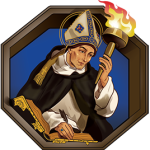
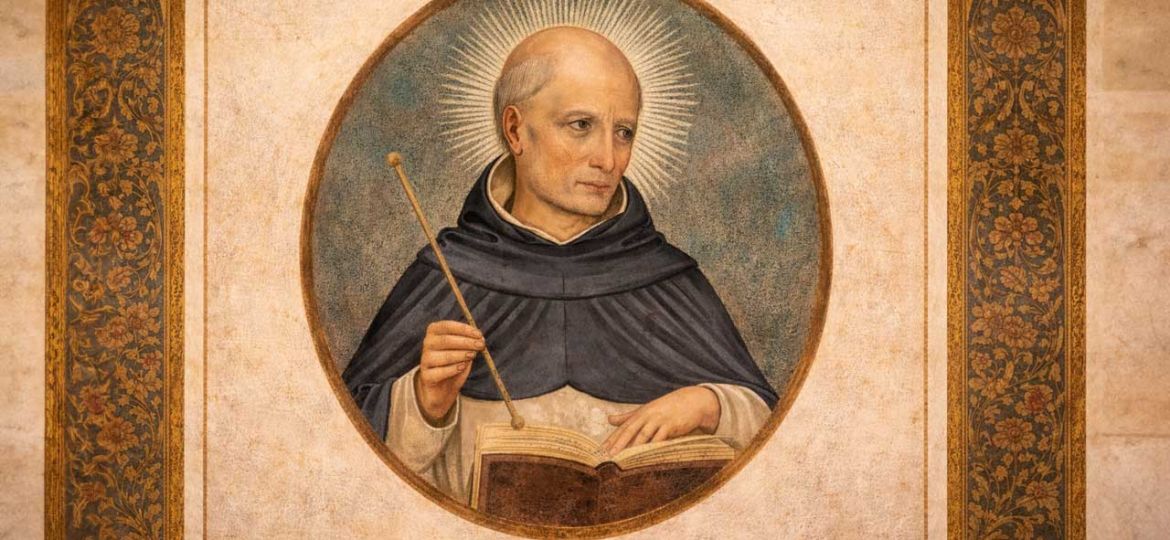
BLESSED JORDAN OF SAXONY, SUCCESSOR OF ST. DOMINIC
Words of Wisdom: “But the fruit of the Spirit is, charity, joy, peace, patience, benignity, goodness, longanimity, mildness, faith, modesty, continency, chastity. Against such there is no law. And they that are Christ’s, have crucified their flesh, with the vices and concupiscences. If we live in the Spirit, let us also walk in the Spirit.... Bear ye one another’s burdens; and so you shall fulfil the law of Christ.... [W]hat things a man shall sow, those also shall he reap. For he that soweth in his flesh, of the flesh also shall reap corruption. But he that soweth in the spirit, of the spirit shall reap life everlasting. And in doing good, let us not fail. For in due time we shall reap, not failing.” (Galatians 5:22-25; 6:2, 8-9 [D-R]) (1)
At the height of the Middle Ages, St. Dominic Guzmán, responding to the Church’s need for priests specially dedicated to learning and preaching, successfully founded an unprecedented form of religious life that would become one of the most prominent and widespread Orders in the Church––the Order of Friars Preachers. Committing themselves wholeheartedly to the study of the truth, to prayer, and to preaching, Dominic and his first followers established a legacy which has continued to enrich the Church for nearly a thousand years.
In the summer of 1221, merely five years after the Order’s foundation, God called Dominic’s soul from this earth to enjoy his eternal reward. As he was dying, Dominic had promised his spiritual children his assistance from heaven; however, his departure left his early disciples destitute of an earthly guide to direct them in his spirit and in the continuation of the Order’s work. (2)
On the feast of Pentecost of the year 1222, nine months after Dominic’s death, Blessed Jordan of Saxony was chosen to be his successor. Having been newly associated with the Dominican Order, Jordan may have seemed to lack the experience necessary to assume the immense labor Dominic had begun; however, Divine Providence arranged that he would be one of the most critical figures of early Dominican history, not only for the growth of the Order, but also for the spiritual edification of its numerous members. (3)
STUDENT AT THE UNIVERSITY OF PARIS
Born in 1190 in the castle of Borrenstrick in Germany, Bl. Jordan of Saxony was the son of the count of Ebernstein. (4) At a young age, he was sent to the University of Paris, one of medieval Europe’s most esteemed centers of higher education. During this time, Jordan followed a holy and studious life, practiced many works of charity, such as almsgiving, and avoided the immorality that was rampant in the city. (5) In addition to having received a bachelor's degree in theology, Jordan also eventually received a master’s degree (which, in the Middle Ages, was equivalent to a doctorate’s) in the liberal arts. (6) Jordan habitually visited Notre-Dame Cathedral, where he attended Matins (the early-morning prayer of the Divine Office) at midnight. One night, as Jordan was walking to Notre-Dame, he was stopped by a poor man who asked for alms. Not carrying any money with him at the time, Jordan gave the pauper his costly belt that was decorated with precious metals and stones. When Jordan arrived at the cathedral, he saw hanging on a crucifix the same belt that he had given to the poor man. (7) This event illustrates how the charity which we show to others is shown to God: “Amen I say to you, as long as you did it to one of these my least brethren, you did it to me” (Matthew 25:40). (8)
DOMINICAN FRIAR
In 1219, at the age of about thirty, Jordan met St. Dominic, who had come to Paris. Their acquaintance quickly grew into a close friendship, and Dominic received Jordan’s entire confidence. However, despite their closeness––and despite the fact that Dominic led Jordan to become a deacon––Jordan did not yet wish to become a part of Dominic’s Order. (9)
However, shortly after Dominic’s departure, one of his first disciples, Blessed Reginald of Orleans, also visited Paris to preach to the students of the university. Jordan was so moved by Reginald’s preaching that he made a vow to become a Dominican friar himself. (10) Accordingly, Jordan, along with his close friend, received the Dominican habit on Ash Wednesday of 1220 at the monastery of St. Jacques in Paris. (11)
FIRST PRIOR PROVINCIAL OF LOMBARDY
Having been a friar for merely two months, Jordan was already considered an ideal disciple of St. Dominic and was thus chosen to be a delegate for the Order’s general chapter that was held in Bologna. Further, shortly thereafter, he was chosen to become the first Prior Provincial (a district superior) of the Dominican Order in Lombardy. (12) Jordan himself later recalled this event with a note of melancholy:
...[T]hey thought fit to impose upon me the office of Provincial of the Province of Lombardy. I had only passed a year in the Order. Before I had time to take root, as was necessary for me, they put me at the head of others, I who had not yet learned how to guide myself in the work of my own salvation. (13)
SUCCESSOR OF ST. DOMINIC
Jordan had just assumed his new office as Prior Provincial of Lombardy when he received news of St. Dominic’s passing. (14) The following year, on May 22, 1222, a general chapter of the Order elected Jordan to be Master General, succeeding St. Dominic as head of the Order. Jordan thus assumed responsibility for the entire Dominican Order, becoming the spiritual father of its many members. (15)
As the new Master General, Jordan’s duties would include regular visitations of the Order’s monasteries, the work of augmenting the number of its members, the management of the practical considerations of the Order, the overseeing of the foundation of new monasteries, and the enforcement of disciplinary measures––such and other duties being directed towards helping the Order to continue faithfully in the spirit and work of St. Dominic, seeing to both its present and future good. (16)
Jordan’s holiness, learning, and deep understanding of human psychology contributed to his qualifications as the new leader of Dominic’s mission. The immense blessings God would soon grant to the entire Dominican Order through Jordan’s efforts attest to his openness to God’s grace as an instrument of Divine Providence. (17)
AUGMENTING THE DOMINICAN ORDER
“In founding priories in university cities,” observes historian Fr. Hinnebusch, O.P., “Dominic intended to enroll the friars for the university courses and to seek vocations from among the students and professors.” (18) This, in great part, is because study, learning, and teaching constitute integral parts of Dominican spirituality. Following the example of St. Dominic, Jordan spent much of his time traveling on foot throughout Europe, stopping at various university cities––such as Paris and Bologna––to preach, particularly with the aim of encouraging young men to pursue religious life in the Dominican Order. (19)
God used Jordan’s gift of eloquence to move over a thousand souls to abandon a worldly life and to embrace the mendicant, preaching life established by St. Dominic. The Order’s monasteries thus became flooded with young men who decided to become friars after hearing Jordan’s preaching. (20) Fr. Gerard de Frachet, an early Dominican biographer, says of Jordan that “...from the time in which religious congregations became established, no one ever led so many learned and distinguished clerics into any Order as he did into the Order of Preachers.” (21)
“SWEET FATHER JORDAN”
Witty, animated, and warmhearted, Jordan is said to have possessed an irresistible charisma that brought joy and peace to those whom he encountered, disarmed his enemies, and instilled fervor in the lukewarm. (22) Jordan became known as “Dulcis Pater Jordanus”––“sweet Father Jordan”––for his kindness and holiness. (23) He possessed great empathy for the suffering, a gentleness in correcting faults, and a constant joyfulness. Jordan particularly showed great charity towards the sick and bedridden, whom he always visited first when arriving at monasteries. Additionally, during such visits to monasteries, he prioritized conversation with the novices and other young members of the Order, offering them his guidance and fortifying them in their vocation. (24)
FRIEND OF BLESSED DIANA D’ANDALO
Among Jordan’s close friends was a saintly Dominican nun, Blessed Diana d’Andalo (d. 1236). Like Jordan, Diana was moved by Bl. Reginald’s preaching to become a part of St. Dominic’s Order. However, as there were no convents of Dominican nuns able to accept her, Diana made a private vow of virginity and her religious profession in the hands of St. Dominic, and she lived as a solitary religious in her family’s home, awaiting an opportunity to join a convent. (25)
As time passed, Diana sought refuge in a community of Augustinians; however, as this was against the will of her parents, she was soon captured by her brothers, who severely injured her, and was confined to her family’s home. (26) After her recovery and eventual freedom, Diana met Jordan, who was seeking potential foundresses for a new Dominican convent in Bologna. With Jordan’s assistance, Diana became one of the foundresses of the new convent. For fourteen years, Jordan and Diana kept a lively correspondence on spiritual matters. (27) Over fifty of Jordan’s letters to Diana and to other persons are extant. (28)
JORDAN’S LETTERS
Jordan’s letters continue to serve as rich and thought-provoking spiritual reading for both religious and laity, as they are replete with reflections on topics such as divine providence, the happiness of heaven, and the value of prayer and sacrifice. For example, in one of his letters, Jordan encourages Diana to entrust herself to God’s unfailing goodness and wisdom:
You must not be anxious about anything, daughter, but take courage and be strong. For your Spouse is Emmanuel, Who does not abandon those who hope in Him, but is with them, just as He Himself promised, unto the consummation of the world. Therefore, confidently cast all your anxieties on Him, Whose power can never be conquered, Whose wisdom never fails, and whose goodness never weakens. Such is your Beloved, Who is able, and knows how, and wishes to deliver you from all your tribulations and difficulties. (Epistola XXXII) (29)
Furthermore, Jordan’s letters to Diana express the interdependence of friars and nuns which St. Dominic intended to exist when he founded his Order––namely, that the nuns, by prayer and sacrifice, would provide the necessary spiritual bulwark for the success of the friars’ preaching; and that the friars, in turn, would provide direction and encouragement to the nuns.
SPIRITUAL GUIDE OF ST. ALBERT THE GREAT
One of the most eminent persons whom Jordan won to the Order is St. Albert the Great (d. 1280). Albert, who, in his early twenties, was already gaining recognition for his talent and scientific expertise, began to consider becoming a Dominican friar; however, he was reluctant to do so from a fear of possibly failing to persevere in religious life. His hesitations were reinforced by what he believed to be a warning from God: a dream in which he saw himself becoming a Dominican friar and, shortly thereafter, leaving the Order. (30)
The morning following this dream, Albert entered a church in which Jordan was preaching, and he was astonished to hear Jordan cautioning young men against a deception that the devil sometimes employs to dissuade persons from pursuing religious life––namely, dreams that portray an aspirant’s failure to persevere as a religious. After hearing this sermon, Albert hurried to meet Jordan, and, with Jordan’s advice and encouragement, Albert made a firm resolution to join the Order. Shortly thereafter, he received the Dominican habit from Jordan himself. (31)
Albert’s connection with the Order would eventually lead him to become the mentor of St. Thomas Aquinas (d. 1274) as well as the Prior Provincial of the Dominican Order in Germany. Moreover, his holiness and learning were such that he became one of the most distinguished saints and bishops of the Dominican Order, a Doctor of the Church, and the patron of scientists.
“THE ROAD TO HEAVEN”
Jordan’s rich spiritual life was marked by a deep love for Our Lady and by a practical understanding of the value of prayer, silence, and recollection. Jordan spent several hours each day and night in private prayer, and he often wept during these times, while saying Mass, and during his sermons. Additionally, while traveling, he often prayed in the form of singing his favorite hymns, such as Jesu Nostra Redemptio and Salve Regina. (32) During such journeys, Jordan, preoccupied in prayer, sometimes unknowingly meandered from the main road. When he and the friars journeying with him became lost as a result, he told his companions: “Be calm, there is but one road about which we should be anxious––the road to heaven.” (33)
During Jordan’s life, God worked several miracles through him, such as the multiplication of food for the poor, the restoration of sight to the blind, and the healing of the sick. (34) On one occasion, while traveling, a few friars accompanying Jordan noticed a weasel crossing the road and hurrying into its hole. When Jordan came to the weasel’s hole, he told it to come out so that he and the other friars could see it. The weasel promptly appeared and allowed Jordan to pick it up and pet it. When Jordan put it down, he said, “Return now into your tiny house, and may God, your Maker, be blessed forever”––at which it returned to its habitation. (35)
Jordan experienced both extraordinary spiritual consolations as well as frequent and unusual temptations and manifestations of the devil, who strove unremittingly to put an end to Jordan’s work for the Order. During most of his life, Jordan suffered with poor health, and he eventually lost his eyesight to a great extent. However, despite these and other crosses, he devoted himself to fulfilling the various duties of his post until the end of his life. (36)
SHIPWRECK
After Jordan departed for a journey to Palestine, Diana died in her convent at the age of thirty-five years; however, this news never reached Jordan. Eight months later, as he was returning to Europe, Jordan himself died in a shipwreck near Acre on February 13, 1237, being forty-seven years of age. Later, on a nearby shore, his body was discovered, around which shone a beautiful light. (37)
Jordan has been venerated in the Dominican Order since his death, and many miracles have been attributed to his intercession. In 1826, Pope Leo XII officially declared him a Blessed of the Church, and he is the patron of Dominican vocations. (38)
ENTRUSTING OURSELVES TO GOD
The position of Prior Provincial and, shortly thereafter, that of Master General, were imposed upon Bl. Jordan long before he felt qualified to occupy such offices. Similarly, we, too, may face situations in which we believe we are incapable of undertaking and completing a work that God seems to ask of us. However, if, like Bl. Jordan, we entrust ourselves to God and ask for the graces to accomplish His holy will, we can be assured that He will suit us to whatever work His Wisdom has arranged for us to perform.
REFERENCES
- Galatians 5:22-25; 6:2; 6:8-9 (The Holy Bible [Douay-Rheims Version]), (Baronius Press, 2017).
- Sister Mary Jean Dorcy, O.P., “St. Dominic” in Saint Dominic’s Family: The Lives of Over 300 Famous Dominicans, (Washington, D.C.: Dominicana Publications; Rockford, IL: TAN Books, 1983), 5.
- Angelus Maria Walz, O.P. “Historia Fratrum Praedicatorum, I. Pars, Ab Initio ad Annum 1507, I. Evolutio generalis.” in Compendium Historiae Ordinis
Praedicatorum, (Romae: Libreria Herder, 1930), 26. - A Sister of the Congregation of St. Catharine of Siena, “February 15 Blessed Jordan of Saxony, Confessor,” in Short Lives of the Dominican Saints, ed. Fr. Procter, S.T.L. (London: Kegan Paul, Trench, Trübner, 1901), 34. Retrieved from: https://archive.org/details/ShortLivesOfTheDominicanSaints.
- “Blessed Jordan of Saxony” in Lives of Some of the Sons of St. Dominic by a Father of the Same Order, First Series, (New York, Montreal: D. & J Sadlier, 1883), 9-11. Retrieved from: https://archive.org/details/LivesOfSomeOfTheSonsOfStDominic.
- William A. Hinnebusch, O.P., D.Ph., “Chapter IX: Northern Dominican Spiritual Writers” in The History of the Dominican Order: Intellectual and Cultural Life to 1500, Volume Two (New York: Alba House 1973), 285.
- Ibid., 10-12.
- Matthew 25:40 (The Holy Bible [Douay-Rheims Version]), (Baronius Press, 2017).
- Lives of Some of the Sons of St. Dominic, 13.
- Ibid., 4.
- Short Lives, 34-35.
- Dorcy, “Blessed Jordan of Saxony” in Saint Dominic’s Family, 22-23.
- Lives of Some of the Sons of St. Dominic, 21.
- Ibid., 21-23.
- Marguerite Aron, “Chapter VI: Master General of the Friars Preachers,” in Saint Dominic’s Successor, (London: Blackfriars Publications, 1955), 82-83.
- Short Lives, 36.
- Fratris Gerardi de Fracheto, O.P., “De Sancte Memorie Fratre Iordane,” Capita Primum, Quintum, Septimum, Quadragesimum Secundum in Vitae Fratrum Ordinis Praedicatorum necnon Cronica Ordinis ab Anno MCCIII usque ad MCCLIV, ed. Fr. Benedictus Maria Reichert, O.P., in Monumenta Ordinis Fratrum Praedicatorum Historica, (Romae: In Domino Generalitia; Stuttgardiae: Apud Jos. Roth, Bibliopolam, 1897), 100-101, 103, 105-106, 137-146. Retrieved from:
https://archive.org/details/vitaefratrumordinispraedicatoreiche/mode/2up. - Hinnebusch, “Chapter I: The Dominican Order and Learning” in History of the Dominican Order, 5.
- Short Lives, 36; Fracheto, Vitae Fratrum, Caput Duodecimum, 108.
- Kevin Vost, Psy.D., “Blessed Jordan of Saxony,” in Hounds of the Lord: Great Dominican Saints Every Catholic Should Know (Manchester, NH: Sophia Institute, 2015), 31; Fracheto, Vitae Fratrum, Caput Duodecimum, 108-109.
- “…[A]b eo tempore quo religiones esse ceperunt, nullus tot litteratos et magnos clericos induxerit ab aliquem ordinam, sicut ipse ad ordinem predicatorum.” Fracheto, Vitae Fratrum, Caput Undecimum, Nota 12, 108.
- Ibid., Capita Quintum, Decimum Quartum, Quadragesimum Secundum, 103, 110-111, 137-146; Dorcy, St. Dominic’s Family, 22-23.
- Lives of Some of the Sons of St. Dominic, 29.
- Fracheto, Vitae Fratrum, Capita Secundum, Quintum, 101, 103; Short Lives, 35; Fr. Jordan DeGuire, OP, “How Do You Follow a Founder?” Dominican Friars Province of St. Albert the Great, USA, 13 February, 2025, https://www.opcentral.org/news/9334.
- Fr. Emmanuel Suarez, O.P., “Die 9 Junii, BB. Dianæ, Cæciliæ et Amatæ, Virg. Ord. Praed.” Lectio ij, in Breviarium Juxta Ritum S. Ordinis Prædicatorum, Pars Prior, (Romæ: ad S. Sabinam, 1952), 1324-1325; “Blessed Jordan and Blessed Diana,” Dominican Nuns Marbury, Alabama, accessed 9 March, 2026,
https://marburydominicannuns.org/blog/blessed-jordan-and-blessed-diana. - “Bl. Diana d’Andalo,” Dominican Sisters of Saint Cecilia, accessed 9, March, 2026, https://www.nashvilledominican.org/community/our-dominican-heritage/our-saints-and-blesseds/bl-diana-dandalo/.
- Suarez, Breviarium, 1324-1325; “Blessed Jordan and Blessed Diana,” Dominican Nuns Marbury, Alabama, accessed 9 March, 2026, https://marburydominicannuns.org/blog/blessed-jordan-and-blessed-diana.
- See Monumenta Ordinis Fratrum Praedicatorum Historica, Vol. XXIII, which contains a collection of fifty-six of Jordan’s letters in their original Latin.
- “Nihil ergo sollicita debes esse, filia, sed confortare et esto robusta. Ipse enim sponsus tuus Emmanuel est, qui non deserit sperantes in se, sed est cum eis, sicut ipse promisit, usque ad consummationem saeculi. Secura ergo proice in eum omnem sollicitudinem tuam, cuius non potest vinci potential nec falli sapientia nec fatigari benignitas. Talis est dilectus tuus, qui potest et scit et vult te de omnibus tribulationibus et angustiis tuis liberare.” Beati Iordani de Saxonia Epistulae, ed. Angelus Walz, O.P., Epistola XXXII, in Monumenta Ordinis Fratrum Praedicatorum Historica, Volumen XXIII, ed. Socii Instituti Historici Fratrum Praedicatorum ad S. Sabinae in Urbe, (Romae: Institutum Historicum Fratrum Praedicatorum, 1951), 38.
- Fr. Thomas Schwertner, O.P., “Early Years” and “The Great Decision,” in St. Albert the Great, (Post Falls, ID: Mediatrix Press), 7, 9, 10, 16-17.
- Ibid., 16-17; Joachim Sighart, Albert the Great of the Order of Friar Preachers: His Life and Scholastic Labours, Chapter III, trans. Fr. T. A. Dixon, O.P., (London: R. Washbourne, 1876), 35-36. Retrieved from: https://archive.org/details/AlbertTheGreatOfTheOrder/mode/2up.
- Fracheto, Vitae Fratrum, Capita Septimum, Vigesimum Tercium, 105-106, 118.
- Lives of Some of the Sons of St. Dominic, 42.
- Fracheto, Vitae Fratrum, Capita Octavum, Nonum, Decimum, 106-108; Lives of Some of the Sons of St. Dominic, 62-63.
- Lives of Some of the Sons of St. Dominic, 45-46.
- Short Lives, 36-37; Fracheto, Vitae Fratrum, Capita Vigesimum Octavum, Vigesimum Nonum, Trigesimum, Trigesimum Primum, 122-125.
- Short Lives, 37. Norbert Georges, O.P., “Chapter X: Last Days and Death” in Blessed Diana and Blessed Jordan of the Order of Preachers, The Story of a Holy Friendship and a Successful Spiritual Direction, (Somerset, Ohio: The Rosary Press, 1933), 69. Retrieved from: http://www.domcentral.org/trad/dijolives.pdf.
- Suarez, Breviarium, “Die 15 Februarii, B. Jordani Saxonis, Conf. Ord. Praed.,” Lectio vj, 1075; Fr. Jordan DeGuire, OP, “How Do You Follow a Founder?” Dominican Friars Province of St. Albert the Great, USA, 13 February, 2025, https://www.opcentral.org/news/9334.