
About the Author
Fr. Neil J. Roy, STL, Ph.D. SAGI Chaplain & Director, Inspiring Faith
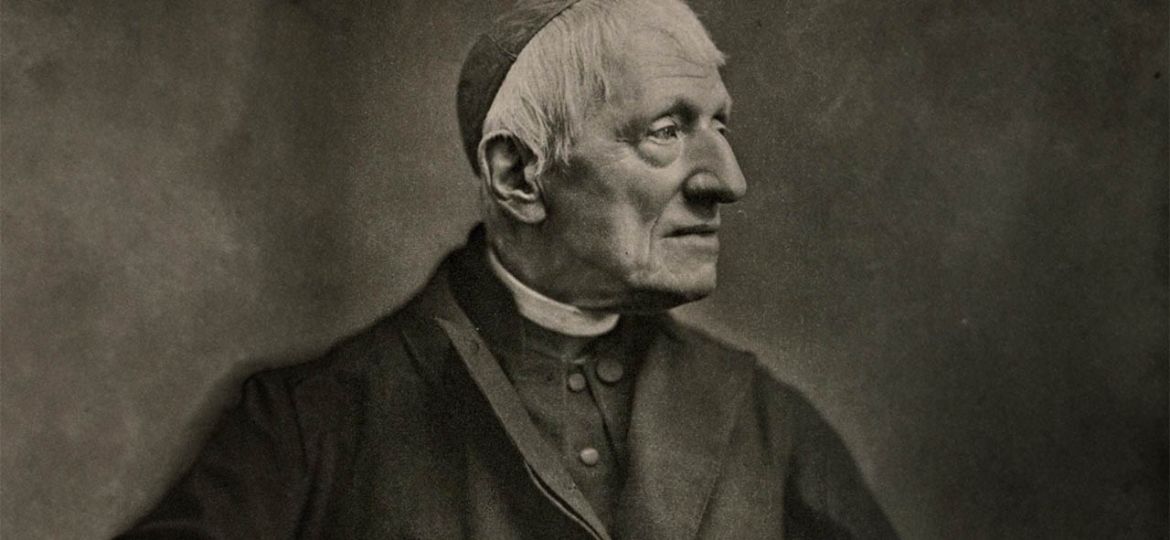
St John Henry Newman To Be Declared a Doctor of the Church
Words of Wisdom: On 31 July 2025 Pope Leo XVI announced that soon St John Henry Newman (1801-1890) would be declared a Doctor of the Church. The Pope did not indicate a specific date for the official proclamation. Nevertheless, the declaration is significant for various reasons.
The Church does not bestow the title of “Doctor of the Church” lightly or indiscriminately. The title of “Doctor” obviously implies that the bearer had engaged in teaching the mysteries of the Christian Faith in an admirable way. Yet far more that this is implied in the encomium of “Doctor of the Church.” Four criteria have been established for recognizing a given saint as a “Doctor of the Church.”
First, the saint – and one must indeed be a saint canonized by the Church before the title of Doctor is conferred – must have exhibited outstanding holiness even among the saints. In other words, the heroic degree of holiness recognized by the canonization process must have been excelled and even surpassed by the candidate. Such a prospect surely is daunting, given the impressive, even awe-inspiring honour roll of holy men and women admitted to the Church’s canon of holiness. Newman, for decades after his 1845 conversion, displayed heroic patience in enduring countless professional setbacks and bore the cross of being misunderstood and resented by his fellow Catholics, especially among the clergy and hierarchy. Newman engaged in vigorous debates, but his driving force was always that relentless pursuit of the truth and its transformative power in one’s life.
Second, the candidate must have demonstrated depth of doctrinal penetration. In other words, the saint must have plumbed deeply the vast richness of some branch of theology, whether systematic (dogmatic), fundamental (apologetic), moral, historical, ascetical, or mystical.
Third, the saint must have produced a sufficiently extensive body of writings capable of being recommended as a summary of the authentic, life-giving tradition of the Catholic Church. With Newman’s remarkable contribution of forty books and 21,000 letters (published in 36 volumes), both the second and third criteria would seem to be eminently satisfied. This is so, particularly when one considers works like The Arians of the Fourth Century (1833), his first book to be published - and indeed it was a best-seller that accelerated his meteoric rise in the academy - or The Development of Christian Doctrine (1845), at the completion of which he was compelled to seek admission to the Catholic Church on 9 October 1845, or An Essay in Aid of a Grammar of Assent (1870) in which he lays out his views on the nature of faith and personal conviction. In addition to weighty books of philosophy and theology, Newman also wrote countless sermons, two novels (Loss and Gain, 1848; Callista, 1855), and various poems, some of which were set to music as timeless hymns (Lead Kindly Light, 1833; Praise to the Holiest in the Height, 1865). His major poem The Dream of Gerontius (1865) explores the area of eschatology, as Newman traces the progress of an old man’s soul from death through Purgatory and judgment to his admission to Paradise. Sir Edward Elgar, who did not know Newman but was quite inspired by his legacy, set The Dream of Gerontius to music and premiered it as an oratorio in 1900.
The fourth criterion remains the official designation by the Apostolic See as a “Doctor of the Church.” This final hurdle will have been surmounted before the conclusion of the Jubilee Year of Hope 2025.
Newman will be the first Doctor of the Church whose writings were composed in English.
The process of Newman’s canonization is worth a quick review. In 1991, the Vatican’s Congregation of the Causes of the Saints declared Newman “Venerable.” On 19 September 2010 Pope Benedict XVI beatified Newman in an open-air ceremony at Cotton Park, Birmingham on his state visit to the United Kingdom. On 13 October 2019 Pope Francis canonized St John Henry Newman in St Peter’s Square.
In preparation for the forthcoming declaration of Newman as a Doctor of the Church, King Charles III visited the Oratory of St Philip Neri at Birmingham on 3 September 2025. The link below highlights the King’s tour of Newman’s foundation, exploring the church, Newman’s library, his private rooms, and the Oratorians’ chapel, now converted into St John Henry Newman’s Shrine. See it here:
38 Doctors of the Church (as of 2025)
(arranged according to their respective regions and eras)
Criteria: (1) outstanding holiness even among saints; (2) depth of doctrinal penetration; (3) sufficiently extensive body of writings capable of being recommended as a summary of the authentic and life-giving tradition of the Catholic Church; (4) official designation by the Apostolic See as a “doctor of the Church.”