

About the Author
Sister Jordan Thomas, O.P. SAGI Torchbearer & SAGI Senior Advisor, Inspiring Faith and Theocentric Education
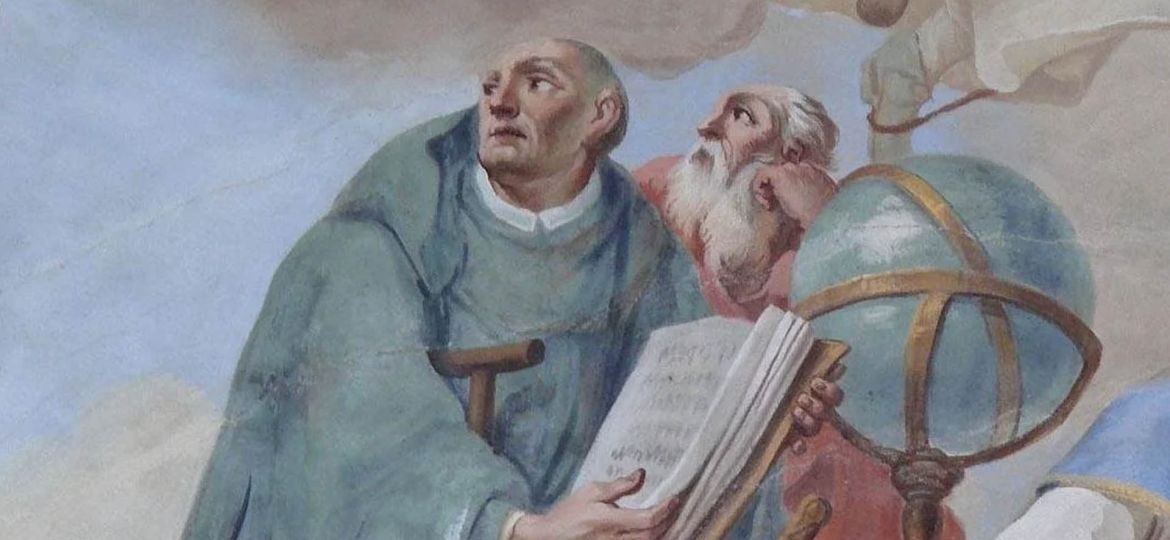
BLESSED HERMANN “THE CRIPPLE” – MONK, ARTIST, AND SCIENTIST
Words of Wisdom: ““Our Lord always wants you on the Cross! Do not fight it but rather think that He is close to you, to support your strength and rekindle your courage when you feel them about to give way.... Do not forget that the way of the Cross is the way to Heaven. Jesus Christ has not traced any other way for us. It is by many sufferings that we must reach the kingdom of heaven; but also all the sufferings of this life are nothing compared to the glory which is to be their reward....” (Letter of Fr. Alexandre-Vincent Jandel, O.P. to his sister) (1)
Throughout the history of the Church, there have been many saints who suffered from physical disabilities and long-term illnesses of various types. Such persons, however, found immense value in their particular crosses because, as many spiritual authors emphasize, suffering sanctifies the person who accepts it for the love of God. Blessed Hermann of Reichenau (d. 1054) is a particularly striking example of one whose physical disabilities affected him to such a great degree that almost every aspect of his daily life was impacted. However, in the face of such adversity, he found true happiness and fulfillment in God’s will, and his suffering sanctified him.
STUDENT AT REICHENAU ABBEY
Hermann, whose parents were noblepersons of eleventh-century Swabia, was born with severe and lifelong disabilities, (2) including cerebral palsy, spina bifida, and a cleft palate. Hermann was thus unable to move on his own, suffered from continuous pain, and would require constant caretaking his entire life. (3)
When Hermann was seven years old, his parents offered him to the Benedictine monks of Reichenau Abbey, located in southern Germany, for his care and upbringing. (4) Although Hermann’s physical limitations were numerous, the monks soon discovered that he was blessed with an extraordinary intellect and multiple talents, and they strove to foster his giftedness by providing him with a thorough education. Hermann, in turn, imbibed the instruction he received, and he took great interest in the study of many various disciplines. (5)
BENEDICTINE MONK
When Hermann came of age, he wished to remain at the monastery and to become a Benedictine monk himself. Although he was unable to participate in most aspects of the regular life of the monks, the community welcomed him as a brother into their spiritual family, and they continued to provide him with the care and accommodations he required. At the age of twenty years, Hermann pronounced his Benedictine vows of obedience, stability, and an ever more perfect conversion to God. (6) At the age of thirty, he was ordained to the priesthood, despite the fact that his disabilities prevented him from saying Mass. (7)
“THE WONDER OF THE CENTURY”
Reichenau Abbey was not only Hermann’s lifelong abode of prayer and sacrifice, but it also served as an auspicious environment in which he could dedicate himself wholeheartedly to study and the exercise of his talents. (8) Known in his time as “the wonder of the century,” (9) Hermann was an eminent polymath whose contributions to sacred studies and liturgy, as well as to scientific and artistic fields, became widely known and celebrated. As a theologian, musician, composer, poet, astronomer, mathematician, and historian, Hermann worked to preserve, explicate, and augment the knowledge of his day across various fields of study, and to direct his theological insights and artistic abilities towards the adornment of the Church’s liturgy. His extensive contributions were not only lauded for their excellence in his own lifetime, but they have also continued, for nearly a thousand years, to enrich both the liturgy and academia. (10)
HERMANN’S CONTRIBUTIONS
Hermann’s magnum opus is a historical chronicle , known in Latin as Chronicon Hermanni Contracti. This work consists of a world history of about eleven centuries, spanning from the time of Christ to Hermann’s own day. Although Hermann left his chronicle unfinished at his death, his close friend and Benedictine confrère, Berthold of Constance, continued Hermann’s work in his stead. (11) In addition to its publication in its original Latin, it has also since been translated and published in German as Die Chronik Herimanns von Reichenau.
Hermann demonstrated particular aptitude in music, as is evident both in his numerous musical compositions as well as in his book on musicology, De Musica. In this treatise, Hermann––in addition to describing various physiological and emotional effects of music––takes a unique approach to the study of music theory by synthesising German and Italian musical traditions. (12) Because of his insights in musicology, Hermann is considered a key contributor to the advancement of music psychology. (13)
Hermann’s poetical output consists of works of various styles, metres, and themes––ranging from theologically profound hymns for the sacred liturgy, to humorous verses addressed to nuns, to a touching poem in honour of his deceased mother. (14) Further, being proficient in several ancient languages––including Arabic, Greek, and Latin––Hermann translated important philosophical works, thus making them more readily available to others. (15)
Among Hermann’s scientific endeavours, he had an especial interest in astronomy and mathematics: his work in these fields include star charts and an important calendrical computation for Easter. Additionally, Hermann popularized certain astronomical instruments––such as the astrolabe––which, until then, had not been widely used in central Europe. (16)
“HAIL, HOLY QUEEN”
Eventually, Hermann became blind and was thus unable to further pursue many of his areas of interest. (17) However, as he faced this new adversity, he spent more time in prayer and in composing timeless hymns for the Church. Two particularly significant hymns among Hermann’s works are “Alma Redemptoris Mater” and “Salve Regina”––the latter of which is known in English as the prayer “Hail, Holy Queen.” (18)
Hermann’s “Salve Regina” has become one of the most well-known and most commonly recited prayers of the Church. Within two centuries, it became incorporated into the nightly recitation of Compline in the Divine Office. Such a practice was further popularized by Blessed Jordan of Saxony (d. 1237), and it continues to this day. (19) “Salve Regina” (or “Hail, Holy Queen”) is also commonly recited by the faithful everywhere as one of the concluding prayers of the rosary.
Among other contributions Hermann made to the enrichment of the Church’s liturgy, he composed music for the feasts of two important German saints: St. Wolfgang (d. 934) and St. Afra (d. 304).(20) Some historians also credit him with the composition of “Veni Sancte Spiritus,” the Sequence hymn for the feast of Pentecost. (21)
HERMANN’S FAITH
Hermann was known not only for his intelligence, but also for his kindness, joyfulness, and constant smile. (22) His sanctity and wisdom, combined with his sweet disposition, drew many eager disciples to him. (23) Hermann considered his disabilities and ailments to be immense blessings, for he knew such things were a means to his being united with God. Hermann’s faith likewise directed him in his academic endeavours: throughout his life, he undertook all such pursuits for the glory of God and for the edification of others.
DEATH
After Hermann had just confided to his friend, Berthold, that he felt his death was approaching, he “added that he was so ‘seized with an ineffable desire and delight toward that intransitory [sic] world and that eternal and immortal life,’ that all things of this passing existence seemed empty and vain....” (24) On September 24, 1054, at the age of forty years, Hermann received his eternal reward. In 1863, during the pontificate of Pope Pius IX, Hermann received beatification in the Church. (25)
HERMANN’S EXAMPLE
Blessed Hermann is an inspiring example of one who, far from allowing his physical limitations to discourage him, rather looked to God’s greater glory in all things, considering it a great blessing to participate, by his particular cross, in Christ’s sufferings. Hermann exemplifies an unwavering fidelity to following God’s will, immense patience, prayerfulness, and dedication to the truth––all of which are of inestimably greater importance than the ability to merely execute practical matters. Although unable to follow many of the normal practices of monasticism, Hermann was nevertheless filled with the spirit of religious life to a degree which few of his fellow monks likely attained. By following a simple life that was deeply shaped by faith, hope, and charity, Hermann became a great saint and a model for all Catholics.
REFERENCES AND NOTES
- Bl. Hyacinthe-Marie Cormier, O.P., Life of the Very Reverend Alexandre-Vincent Jandel, O.P., Seventy-Third Master General of the Friars Preachers, trans. George G. Christian, O.P., and Richard L. Christian, (New Priory Press, 2014), 302.
- John L. Snyder, Introduction to The Musica of Hermannus Contractus, edited and translated by Leonard Ellinwood (Rochester, NY: University of Rochester Press, 2015), 2, 6. Retrieved from:
https://ia903202.us.archive.org/14/items/ellinwood-2015-the-musica-of-her-mannus-contractus/Ellinwood%202015%20The%20Musica%20of%20Hermannus%20Contractus.pdf. - “Blessed Herman The Cripple,” Saint for a Minute, accessed August 27, 2025,
https://www.saintforaminute.com/blesseds/blessed_herman_the_cripple;
Samuel Willoughby Duffield, “Chapter XV. Hermannus Contractus and the ‘Veni Sancte Spiritus’” in The Latin Hymn-Writers and Their Hymns, ed. Prof. R. E. Thompason, (New York; London: Funk and Wagnalls, 1889), 150.
Retrieved from: https://archive.org/details/latinhymnwriters0000unse/mode/2up. - “Bl. Herman the Cripple,” Catholic Online, accessed August 28, 2025,
https://www.catholic.org/saints/saint.php?saint_id=283. - Swope, Cheryl. “Blessed Hermann.” Memoria Press. February 10, 2022.
https://www.memoriapress.com/articles/blessed-hermann/. - “Blessed Herman The Cripple,” EWTN Great Britain, accessed September 2,
2025. https://ewtn.co.uk/blessed-herman-the-cripple/. Geudens, “Saint Norbert” in Encyclopedia, Vol. XI., 100-101. - “Hermann der Lahme,“ Reichenau Kultur-Marketing-Tourismus, accessed September 29, 2025.
https://www.reichenau-tourismus.de/de/erleben/unesco-welterbe/geschichte/hermann-der-lahme. - “Blessed Herman The Cripple,” Saint for a Minute, accessed October 16, 2025,
https://www.saintforaminute.com/blesseds/blessed_herman_the_cripple. - “Das Leben Hermanns des Lahmen,“ Hermannus Gemeinschaft Altshausen, accessed September 29, 2025. https://hermann-von-altshausen.de/leben/.
- Patricius Schlager, “Hermann Contractus” in The Catholic Encyclopedia, Vol. VII. (New York: Encyclopedia Press, 1913), 266.
- Ibid.; Michael Ott, “Berthold of Reichenau” in The Catholic Encyclopedia, Vol. II. (New York: Encyclopedia Press, 1913), 521.
- Cover endorsement of The Musica of Hermannus Contractus, ed. and trans. by Ellinwood Retrieved from:
https://ia903202.us.archive.org/14/items/ellinwood-2015-the-musica-of-her-mannus-contractus/Ellinwood%202015%20The%20Musica%20of%20Hermannus%20Contractus.pdf. - Stagnaro, Angelo. “God Lifted up Bl. Herman the Cripple to Scatter the Proud in Their Conceit.” National Catholic Register. September 24, 2016. https://www.ncregister.com/blog/god-lifted-up-bl-herman-the-cripple-to-scatter-the-proud-in-their-conceit.
- Duffield, The Latin Hymn-Writers, 153-154.
- Ibid., 150-151.
- Philip Kosloski. “These saints were influential astronomers who wed science and faith together.” Aleteia. April 19, 2018.
- “Blessed Herman The Cripple,” Saint for a Minute, accessed October 17, 2025. https://www.saintforaminute.com/blesseds/blessed_herman_the_cripple.
- Stagnaro, Angelo. “God Lifted up Bl. Herman the Cripple to Scatter the Proud in Their Conceit.” National Catholic Register. September 24, 2016. https://www.ncregister.com/blog/god-lifted-up-bl-herman-the-cripple-to-scatter-the-proud-in-their-conceit.
- “The Salve,” Dominican Sisters of Saint Cecilia, accessed September 30, 2025. https://www.nashvilledominican.org/prayer/our-lady/the-salve/.
- “God Lifted Up Bl. Herman The Cripple To Scatter The Proud In Their Conceit,” EWTN Great Britain, accessed October 17, 2025. https://ewtn.co.uk/blessed-herman-the-cripple/.
- Duffield, The Latin Hymn-Writers, 160-166.
- “Disabilities didn’t stop this brilliant monk,” Aleteia, accessed October 17, 2025. https://aleteia.org/2018/09/25/the-inspiring-story-of-how-a-blind-crippled-monk-composed-the-salve-regina/.
- Schlager, “Hermann Contractus” in Encyclopedia, Vol. VII., 266.
- Duffield, The Latin Hymn-Writers, 154.
- “Blessed Herman The Cripple,” Saint for a Minute, accessed October 17, 2025.
https://www.saintforaminute.com/blesseds/blessed_herman_the_cripple.